Sunday, September 9, 2012

100 year old food market in Cleveland, Ohio


Inside Cleveland's West Side Market. Photo taken around 11 am on a weekday when there was little traffic in January 2012.
West Side Market
Cleveland, Ohio USA


Cleveland's West Side Market is 100 years old this year.

I shop there.

It is full of good food and interesting people.
If you will be attending any of the workshops India Flint will be giving in Cleveland this fall, I insist that you arise early in the morning on a Friday or Saturday. They open at 7 am,  take in this wonderful market located at West 25th Street and Lorain, free parking in back. Directions here and then attend the workshop.
Veggie stalls at the West Side Market, Cleveland, Ohio @ January 2012


Inside the Mediterranean food store at the West Side Market in Cleveland, Ohio 9.8.12

Crepes anyone?


Sunday, September 2, 2012

Start Anywhere on Labor Day

.
Christine Mauersberger, Guide, detail, 2011, hand stitched on deconstructed wool skirt.

It is Labor Day weekend in the U.S. Where Americans honor working people.

Yesterday morning, a former college classmate and I had a short instant message conversation on Facebook. She asked "I am thinking of starting to draw again, but need some motivation...got any good ideas to help motivate me?"

I gave her the link to Bruce Mau's  An Incomplete Manifesto for Growth. Number 9 is my favorite mantra at times of low energy. 

Presently, I am in a good place with my labor (heh, pun is intended).

Enjoy your weekend!


1. Allow events to change you. You have to be willing to grow.
Growth is different from something that happens to you. You produce
it. You live it. The prerequisites for growth: the openness to experience
events and the willingness to be changed by them.
2. Forget about good. Good is a known quantity. Good is what we
all agree on. Growth is not necessarily good. Growth is an exploration of
unlit recesses that may or may not yield to our research. As long as you
stick to good you’ll never have real growth.
3. Process is more important than outcome. When the
outcome drives the process we will only ever go to where we’ve
already been. If process drives outcome we may not know where we’re
going, but we will know we want to be there.
4. Love your experiments (as you would an ugly child).
Joy is the engine of growth. Exploit the liberty in casting your work as
beautiful experiments, iterations, attempts, trials, and errors. Take the long
view and allow yourself the fun of failure every day.
5. Go deep. The deeper you go the more likely you will discover
something of value.
6. Capture accidents. The wrong answer is the right answer in
search of a different question. Collect wrong answers as part of the
process. Ask different questions.
7. Study. A studio is a place of study. Use the necessity of production
as an excuse to study. Everyone will benefit.
8. Drift. Allow yourself to wander aimlessly. Explore adjacencies. Lack
judgment. Postpone criticism.
9. Begin anywhere. John Cage tells us that not knowing where to
begin is a common form of paralysis. His advice: begin anywhere.
10. Everyone is a leader. Growth happens. Whenever it does,
allow it to emerge. Learn to follow when it makes sense. Let anyone
lead.
11. Harvest ideas. Edit applications. Ideas need a dynamic, fluid,
generous environment to sustain life. Applications, on the other hand,
benefit from critical rigor. Produce a high ratio of ideas to applications.
12. Keep moving. The market and its operations have a tendency to
reinforce success. Resist it. Allow failure and migration to be part of your
practice.
13. Slow down. Desynchronize from standard time frames and
surprising opportunities may present themselves.
14. Don’t be cool. Cool is conservative fear dressed in black. Free
yourself from limits of this sort.
15. Ask stupid questions. Growth is fueled by desire and
innocence. Assess the answer, not the question. Imagine learning
throughout your life at the rate of an infant.
16. Collaborate. The space between people working together is
filled with conflict, friction, strife, exhilaration, delight, and vast creative
potential.
17. ——————————. Intentionally left blank. Allow space for
the ideas you haven’t had yet, and for the ideas of others.
18. Stay up late. Strange things happen when you’ve gone too far,
been up too long, worked too hard, and you’re separated from the rest
of the world.
19. Work the metaphor. Every object has the capacity to stand for
something other than what is apparent. Work on what it stands for.
20. Be careful to take risks. Time is genetic. Today is the child of
yesterday and the parent of tomorrow. The work you produce today
will create your future.
21. Repeat yourself. If you like it, do it again. If you don’t like it, do it
again.
22. Make your own tools. Hybridize your tools in order to build
unique things. Even simple tools that are your own can yield entirely new
avenues of exploration. Remember, tools amplify our capacities, so even
a small tool can make a big difference.
23. Stand on someone’s shoulders. You can travel farther
carried on the accomplishments of those who came before you. And
the view is so much better.
24. Avoid software. The problem with software is that everyone
has it.
25. Don’t clean your desk. You might find something in the
morning that you can’t see tonight.
26. Don’t enter awards competitions. Just don’t. It’s not
good for you.
27. Read only left-hand pages. Marshall McLuhan did this. By
decreasing the amount of information, we leave room for what he called
our “noodle.”
28. Make new words. Expand the lexicon. The new conditions
demand a new way of thinking. The thinking demands new forms of
expression. The expression generates new conditions.
29. Think with your mind. Forget technology. Creativity is not
device-dependent.
30. Organization = Liberty. Real innovation in design, or any
other field, happens in context. That context is usually some form of
cooperatively managed enterprise. Frank Gehry, for instance, is only able
to realize Bilbao because his studio can deliver it on budget. The myth
of a split between “creatives” and “suits” is what Leonard Cohen calls a
‘charming artifact of the past.’
31. Don’t borrow money. Once again, Frank Gehry’s advice. By
maintaining financial control, we maintain creative control. It’s not exactly
rocket science, but it’s surprising how hard it is to maintain this discipline,
and how many have failed.
32. Listen carefully. Every collaborator who enters our orbit brings
with him or her a world more strange and complex than any we could
ever hope to imagine. By listening to the details and the subtlety of their
needs, desires, or ambitions, we fold their world onto our own. Neither
party will ever be the same.
33. Take field trips. The bandwidth of the world is greater than that
of your TV set, or the Internet, or even a totally immersive, interactive,
dynamically rendered, object-oriented, real-time, computer graphic–
simulated environment.
34. Make mistakes faster. This isn’t my idea — I borrowed it. I
think it belongs to Andy Grove.
35. Imitate. Don’t be shy about it. Try to get as close as you can. You’ll
never get all the way, and the separation might be truly remarkable.
We have only to look to Richard Hamilton and his version of Marcel
Duchamp’s large glass to see how rich, discredited, and underused
imitation is as a technique.
36. Scat. When you forget the words, do what Ella did: make up
something else … but not words.
37. Break it, stretch it, bend it, crush it, crack it, fold it.
38. Explore the other edge. Great liberty exists when we avoid
trying to run with the technological pack. We can’t find the leading edge
because it’s trampled underfoot. Try using old-tech equipment made
obsolete by an economic cycle but still rich with potential.
39. Coffee breaks, cab rides, green rooms. Real growth
often happens outside of where we intend it to, in the interstitial spaces
— what Dr. Seuss calls “the waiting place.” Hans Ulrich Obrist once
organized a science and art conference with all of the infrastructure of
a conference — the parties, chats, lunches, airport arrivals — but with
no actual conference. Apparently it was hugely successful and spawned
many ongoing collaborations.
40. Avoid fields. Jump fences. Disciplinary boundaries and
regulatory regimes are attempts to control the wilding of creative life.
They are often understandable efforts to order what are manifold,
complex, evolutionary processes. Our job is to jump the fences and
cross the fields.
41. Laugh. People visiting the studio often comment on how much we
laugh. Since I’ve become aware of this, I use it as a barometer of how
comfortably we are expressing ourselves.
42. Remember. Growth is only possible as a product of history.
Without memory, innovation is merely novelty. History gives growth a
direction. But a memory is never perfect. Every memory is a degraded
or composite image of a previous moment or event. That’s what makes
us aware of its quality as a past and not a present. It means that every
memory is new, a partial construct different from its source, and, as such,
a potential for growth itself.
43. Power to the people. Play can only happen when people
feel they have control over their lives. We can’t be free agents if we’re
not free

Sunday, August 26, 2012

Safe and Warm

Stitching on a vintage piece of wool.
I found several muddy colored wool blankets at the thrift store a few years ago.
Until a few months ago, I used them to ward-off the cold draft in my spare bedroom/workroom by rolling them up and shoving them up against the base of the wall.

And they did their assigned job.

I had intended to stitch into the wool from first love. The needle dives into the wool with pleasure and is much easier to work compared to tightly-woven cotton. No thimble needed.
The plaid pieces are from a wool scarf my family inherited from my fathers Boy Scout Master when he passsed away in the early 1970's. I was a teen then and fell hard for this woven treasure. 
Work in Progress as of 8/26/2012, Christine Mauersberger
What it looked like when auditioning a circle of black and green  that I removed from a  piece of found fabric. circa June/July 2012.

This did not speak to me.

When I added rows of red stitching...again, it did not sing,
Snip went the scissors. Last night, before adding the plaid wool.

Friday, August 24, 2012

Tree Rings and Time Travel

Can't I just cut a tree open and pick a time to travel to visit with my mom?

Tree ring in my neighborhood, August 23, 2012. Andrew Douglass,  used rings to study the stars. He is the forefather of Dendrochronology . I took a picture of this on Wednesday evening during my 2 mile walk around my neighborhood because it spoke to me. 
Then I heard a radio show today called Science Friday where they spoke about the study of Tree Rings. So here we go, we're all connected.
Deadgrass in my neighborhood, Aug. 23, 2012
Someone killed their grass in order to plant new grass.
I was perplexed and intrigued and moved to photograph this  strange sight. I have not altered the color of the grass, evidenced by the yellow stripe in the upper left hand corner, which is the road stripe.
I am moving forward, making stitch marks on the apron shared between me and my mom. 


The layout for the artwork is here.

One of my good friends said that no one can tell you how to grieve. 

I am my mothers daughter, it is a strange and new place these days. I appreciate you. 
I will move on and be a stronger woman for all of us.

Gosh, I better be, we've got such a fight in the USA these days. 

Let's go women!!!


Friday, August 17, 2012

Momma Momma Momma


My mom passed away yesterday in the wee hours of the morning. We held vigil bedside from last Saturday night at 1 am until early Thurs morning. Each hospice nurse or aid treated my mother with dignity throughout her stay and in her final 5 days with the most respectful care one could imagine.

From the night nurses entering the room as if walking on air for they made almost no sound, with small flashlight in hand to check her, or if they needed to turn a light on, to cover her closed eyes with a tissue.

To the day and evening nurses ministering to her body with soft touches and repositioning her body regarding her as a fragile vintage china plate and gently whispering in her ear perchance she could hear them.

To the nun who came each day to pray over her and with me and my siblings. Offering us a chance to connect to a spiritual power to ease mom's pain. 


At times, I've shared a bit about my momma here here  here and here. I hope you don't mind if I share a few pictures of her busy hands and help me grieve for her.

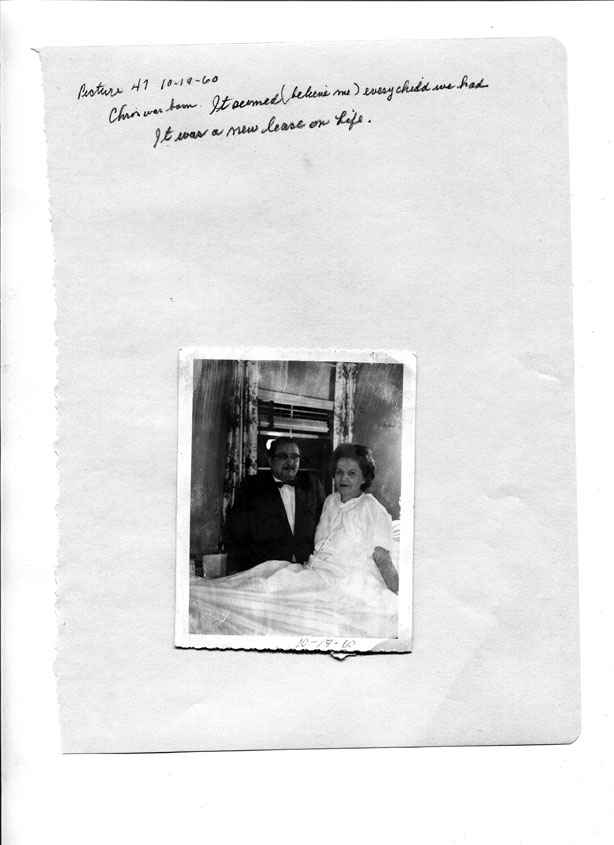
My parents on the day I was born when she was 42.
I asked my mom to write a bit about this photo. She had 12 births and not all of them survived more then 10 months due to illnesses.


"Picture 47 10-17-60. Chris was born. It seemed (believe me) every child we had...It was a new lease on Life"


Mom removing my stitching at my request.


Making rugala cookies at my house


Ironing at my house

Deconstructing a silk blouse for me to use in my artwork 


Bertha Sulak 1918- 2012
One of her crochet-circles hanging in my window


The love she gave to every one of us is embedded in her legacy of over 71 progeny, of children, grand children, great grand children and even great great grandchildren.


In the river I know I will find the key
And your voice will rise like the spray
In the moment of knowing
The tide will wash away my doubt
'Cause you're already home
Making it nice for when I come home
Like the way I find my bed turned down
Coming in from a late night out.
Please keep reminding me
Of what in my soul I know is true

Come in my boat, there's a seat beside me
And two or three stars we can gaze into...

I'll wait no more for you like a daughter,
That part of our life together is over
But I will wait for you forever
Like a river... 

Carly Simon


Friday, August 10, 2012

Preserving Favorite Work Items

Apron, repaired and patched by me and previously by my momma.
 I hand-stitched onto some of my old dishclothes.

Aprons are a marvelous piece of apparel. I used to daydream that I would become a nun, mostly to be able to wear a long black frock. OK, that has nothing to do with aprons...
This good old gal has been mine for 20 years or so. My mom repaired it a few times and reinforced the neck loop.  
I'm thinking about doing some hand-stitching all over this white helper.
Stay tuned. 
The machine stitched lines are from when my mom repaired my apron.
Apron, detail
Update on this piece, I've removed the crosses and have started to stitch more circles onto the surface.  To be continued...

Saturday, August 4, 2012

Blue now part 2 and Gravity and Grace


I keep working this piece. Haven't quite settled on the layout. It will come.


On Wednesday, I went to The Akron Art Museum to see the work of El Anatsui
El Anatsui, Mask of Human Kind, 2010 Aluminum and copper wire

El Anatsui, Red Block, 2010 Aluminum and copper wire
 
El Anatsui, DETAIL,  Red Block, 2010 Aluminum and copper wire


El Anatsui, DETAIL,  Red Block, 2010 Aluminum and copper wire


In the meantime, I am taking a Reiki I and II course as I write this post. I appreciate the intuitive nature of the Reiki healing process.


I hope each of you are experiencing joy and pleasure this weekend.


Cheers!


Wednesday, August 1, 2012

Blue Now


Work in process. Some of the vintage fabrics have been over-dyed in an simple indigo vat while I was in  Michigan.


The light pale green swatch in the left column is a piece of my own baby blanket. My momma's 'go-to' choice for comfort. I know that some of my older sibs enjoyed this blanket before I was born, and most definitely my younger sister, Annette, cuddled with it. 

I cut into the little blanket last night and then I brought a swatch to my mom at the hospice. She held it, her finger tips that have turned blue as is what happens when the body begins to stop having a capillary response, and I was glad to tell her that I was using part of the blanket in a new work. 

I visualized her as a baby herself, then  she turned towards me and  asked whether I could make a little shawl for her shoulders with what I might have left.

Tears aside, here are some details as it is in process and will be stitched and handled with care.


Detail, spirograph image. I drew this spirograph with blue ink on paper, then scanned and printed it on an inkjet printer on cotton. The orange spirograph is printed on  a gauzy-type material- not sure I'll keep the orange. 

I printed these pieces in 2008, so I think they're fairly light fast...not that I really worry about that.


Some of the versions before I decided on a layout


More versions before I decided on a layout


My work is about the mapping of time. 

How do we map time?

When does it change? How do we know? why should I make these marks? Does it matter?

Each stitch is a mark of my time. Waiting, thinking, dreaming and wanting something to happen or not to happen. 

How do you spend time? 


Sunday, July 29, 2012

Paul Yanko: Tectonics

Paul Yanko
Originally from Ohio, now resides in South Carolina, USA
Green Shift Angle, Mixed media and collage on panel, 12 3/8"h x 12 3/8"w, 2010-2011


Social media can be a good thing. 
My friend, Terry Jarrard Dimond  whom I met on FaceBook and whom I have written about here, published an article about Paul Yanko the other day on her blog here.


Terry said that Paul has a show of his work at Proximity Gallery in Cleveland, Ohio.  Paul is formerly from Ohio and now lives and teaches in South Carolina where Terry lives. (Our lives our connected in such freakishly cool ways)


On Saturday afternoon, I stopped in to see the show and meet the owners, Beth Whalley and Alex Kelly. Two super talented and industrious artists, who had met while they were both in a drawing class taught by Paul when they were in art school (I love this story) and who became engaged to be married when they were installing Paul's work in their gallery.


I was thrilled to see Paul's work in person. I didn't realize that some of the pieces are quite small, while others are larger.


Detail, Paul Yanko (I didn't write the name of the piece down- sorry!)
The fractured shapes have a thin bead of paint that bleeds out from under (or around) the form. His solution to deconstructing the grid is to work a piece over time and to respond to what whats by chance. (please read about his process on Terry's blog.)
To me, his paintings evoke shifts of subterranean layers of rocks and gems.
Detail, Paul Yanko (I didn't write the name of the piece down- sorry!)
He may return to the gallery for a closing night talk. If he does, I will be sure to attend. And if you live in or near Cleveland, stop in and see this show. It is on view through September 1, 2012.


I've made new connections in Cleveland and hope to see more work at Proximity Gallery in the future.


Many thanks to Terry for the link and to Paul for the glorious work!

Tuesday, July 24, 2012

Veering off the grid

I wrote about this piece earlier here
when it looked like this:

 A few lines of stitching have been removed and added a few more lines of movement to reflect the changes occurring in my own life as is relates to my momma. There is no real straight line movement in life. It is dynamic and veers off into uncomfortable directions. 


There are a few loose thread in the upper right corner, but those will be sewn into the black  ground.


A few stitches I made yesterday from the start of this